
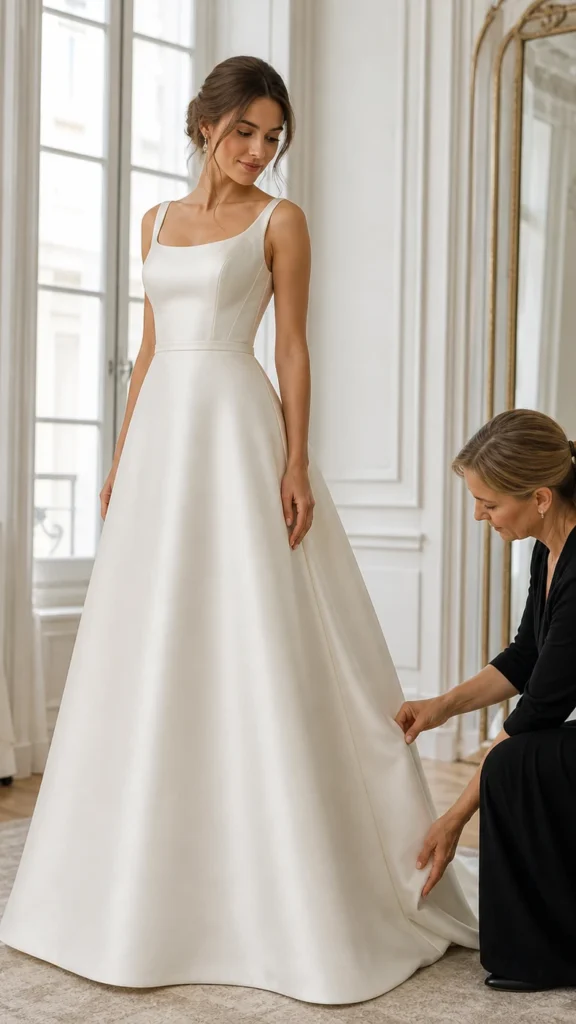
A wedding dress petticoat can completely change how a gown falls, moves and feels. The right underskirt supports the weight of the skirt, creates cleaner volume and can even give your legs more space underneath a full wedding dress.
But more hoops do not automatically mean a better result. A lightweight A-line gown may need only gentle structure, while a heavy princess or ball gown can benefit from a wider three-hoop foundation.
This guide explains how to choose between 1, 2 and 3 hoops, when a bridal underskirt is useful and what to check before ordering.

1. What does a wedding dress petticoat actually do?
A bridal petticoat sits underneath the wedding gown and supports the skirt away from the legs. Depending on its construction, it can create subtle A-line volume or a much fuller princess silhouette.
A hoop petticoat uses flexible rings to maintain its shape. This means the volume does not depend entirely on layers of heavy fabric, making a well-designed hoop underskirt surprisingly lightweight.
It can also make walking easier under a large skirt because the outer dress is held farther away from the bride’s feet.
2. One hoop: best for lighter A-line volume
One hoop is usually the most subtle option. It gives the lower part of the skirt some structure without dramatically increasing the overall width of the dress.
This can work well with softer A-line wedding gowns, lightweight skirts and brides who want the dress to keep a natural rather than strongly structured silhouette.
The 1-hoop option in our adjustable bridal petticoat has a bottom circumference of approximately 220 cm, giving the dress support while keeping the silhouette relatively controlled.
3. Two hoops: the balanced middle option
A two-hoop wedding dress underskirt gives more consistent support through the lower skirt. It is an excellent middle ground when one hoop does not provide enough structure but a full three-hoop silhouette would be too wide.
This option works particularly well for many classic A-line wedding dresses.
Our 2-hoop version has an approximately 235 cm bottom circumference, creating additional space and shape without immediately turning the gown into a full ball gown silhouette.
4. Three hoops: better support for fuller or heavier skirts
Three hoops are not automatically better for every bride, but they become especially useful when the wedding dress has a large or relatively heavy skirt.
Multiple support points help maintain a more consistent shape from the waist toward the hem rather than asking one lower hoop to support the entire silhouette.
Our 3-hoop option has an approximately 270 cm bottom circumference and is designed for fuller A-line, princess and ball gown silhouettes.
If your gown has substantial layers, heavier satin, embellishment or a naturally wide skirt, this is usually the first option worth trying.
View the WonderBridalAtelier 1–3 Hoop Bridal Petticoat .

5. Heavy wedding dress vs lightweight wedding dress
For a heavy wedding dress
A heavier skirt needs enough structure to maintain the shape intended by the gown. A stronger two- or three-hoop bridal petticoat can help support that volume and prevent the skirt from collapsing inward around the legs.
Three hoops are particularly useful when the gown is designed to have a wide A-line, princess or ball gown silhouette.
For a lightweight wedding dress
More structure is not always desirable. Under chiffon, lightweight crepe or another very fluid skirt, an oversized hoop petticoat can change the natural character of the gown.
A one-hoop or smaller two-hoop option is often a better starting point if you simply want a little separation between the dress and your legs.
6. Can the hoops show through a wedding dress?
Yes, they can in some dresses, and this is one of the most important things to understand before buying any hoop underskirt.
Our petticoat combines flexible hoops with firm tulle, which helps soften the structure underneath the gown. However, if the outer wedding dress is made from a very thin, smooth or minimally lined fabric, the outline of a hoop can sometimes become visible.
This does not necessarily mean the petticoat is the wrong size or poorly made. It means the dress does not contain enough fabric between the hoop structure and the outer layer to completely diffuse its shape.
For very thin gowns, test the petticoat under the actual dress before the wedding. If necessary, a seamstress can add a lightweight smoothing layer, lining or additional tulle between the hoops and the outer skirt.
For heavier satin, layered tulle, lace and structured bridal fabrics, the hoop structure is generally much easier to conceal.
7. Adjustable waist matters more than many brides expect
The petticoat must sit securely at the natural waist. If it is too loose, the entire underskirt can move downward during walking. If it is unnecessarily tight, it becomes uncomfortable during a long wedding day.
The WonderBridalAtelier petticoat uses a wide elastic waistband and an adjustable fit designed for approximately XS through L, with the listed maximum waist measurement around 95 cm.
That flexibility is useful because the same basic petticoat construction can accommodate several waist sizes without requiring a completely different rigid waistband.
Always measure your waist before ordering rather than choosing only from your normal clothing size.
Does a three-hoop petticoat make a wedding dress too big?
Not necessarily. The result depends on the shape and fabric of the wedding gown.
Under a full princess dress, three hoops may simply restore the shape the designer intended. Under a narrow A-line dress, the same underskirt could create more volume than the gown can comfortably accommodate.
The correct petticoat should support the dress rather than stretch the skirt outward unnaturally.
Which petticoat should you choose?
As a simple starting point:
- 1 hoop: lighter A-line gowns and subtle lower-skirt support.
- 2 hoops: classic A-line dresses needing balanced structure.
- 3 hoops: fuller A-line, princess and ball gowns, especially when the skirt needs stronger support.
The fabric is just as important as the silhouette. A heavy layered gown can hide and use hoop structure very effectively, while an extremely thin dress requires more attention to whether the ring lines remain visible.
Why brides choose our adjustable bridal petticoat
Our design is intentionally simple: lightweight construction, flexible hoops, firm tulle and a wide adjustable elastic waistband rather than unnecessary heavy layers.
You can choose between 1, 2 and 3 hoops depending on the volume your gown needs, instead of buying one fixed silhouette for every dress.
Customers have specifically mentioned receiving the result they expected, fast delivery and helpful personal guidance when deciding which petticoat to choose.
That last point is important because the best bridal underskirt is not simply the one with the most hoops. If you are unsure, send us a photograph of your wedding dress and we can help you choose the most suitable option.
Wedding dress petticoat buying checklist
- Check your natural waist measurement.
- Look at the silhouette of your wedding dress.
- Consider how heavy the skirt is.
- Check whether the outer fabric is thin enough for hoop lines to show.
- Compare 1, 2 and 3 hoop widths rather than assuming more volume is better.
- Try the complete dress and petticoat together before the wedding day.
A good wedding dress petticoat should almost disappear once the gown is on. You should notice a cleaner silhouette, easier movement and better support rather than the structure underneath.
Shop the WonderBridalAtelier 1–3 Hoop Wedding Dress Petticoat on Etsy



Leave a comment